Hardware
·
2026

Luma
Luma is a calm, visual reminder device that replaces noisy alarms and pings with elegant ambient light.
Visit the site

About the current state of notifications…
Luma began with a simple irritation: every reminder in my life arrived as an interruption, and a pretty binary choice: you can either dismiss or snooze it. The constant buzzing, picking up my phone, getting distracted and immediacy that this notifications demand was overwhelming.
I wanted an object that could hold a reminder the way a sticky note does: present, patient, and silent.
Light as language
The answer, turns out, is light. Luma sits on my desk, kitchen counter or living-room and shifts through slow gradients as deadlines approach, so a glance tells you everything without a single sound. Color-coding reminders serves as an immediate way to categorize and ‘label’ reminders, which can be left “on” for indefinite time —or until the time is right— before tapping on the Luma to dismiss it.
The project covers industrial design, a custom PCB, and the firmware that maps time to light.

Iterations, iterations, iterations…
From start to finish, the project went through many many iterations trying to find the right balances for the type of components, space, and design. One of the hardest but most fulfilling tasks was to always keep in mind Design for manufacturing. With the idea of someday putting the project through its paces in the real world, every corner I beveled or component I added had to pass a strict filter for price, size, and viability.
Working with such constraints made some choices easier, and others harder.

The initial design
The design consists of three main components: The base, the PCB and the acrylic top:


Initial explorations involved whipping out the ‘ole KiCad and testing the right amount of LEDs and the sizing. Working with such a small enclosure, the relationship between the thickness of the acrylic and the distance between it and the LEDs is what determines the amount of diffusion, along with the type of acrylic used.
Earlier prototypes included the ESP-32 microcontroller as a full kit soldered on top, but later on I opted for creating my own schematics for the module, as this is cheaper and allows me to position the USB-C port independently from the microcontroller, which opened the doors for more customization and freedom to arrange the components.
The button
The heart and uniquely interactive piece of this product is the button. I wanted Luma to be as simple as possible to interact with, it should come without a second thought. When it started, the idea was to have a button on the bottom side of the PCB. Pressing the device into the surface it is resting would click the button.

This worked well for the first prototypes, but eventually, I had to come up with another solution: assembling and soldering components on both sides of the PCB is doubly expensive vs. just one side. And the button was the only component on the backside. I spent several weeks trying to come up with different mechanisms, but most of them added extra pieces, fastening, or assembly steps. In the end, everything clicked together and I added a small bump protruding from the aluminum case. While this brings up the cost of the enclosure, it’s a lot less than the double-sided-pcb assembly. Then, by cutting holes in the enclosure for the rubber feet, pressing down on the device lifts slightly the PCB, which makes the button click against the enclosure.

Final touches
Getting to the first 90% is the fun part. For the last 10%, of course, it becomes a lot about fine-tuning, adding safety (fuses, diodes, tweaking thermal conductivity…), and finalizing details. I have been in touch with some wonderful people from suppliers in China who have been very kind to provide samples and test CNC-milled enclosures.
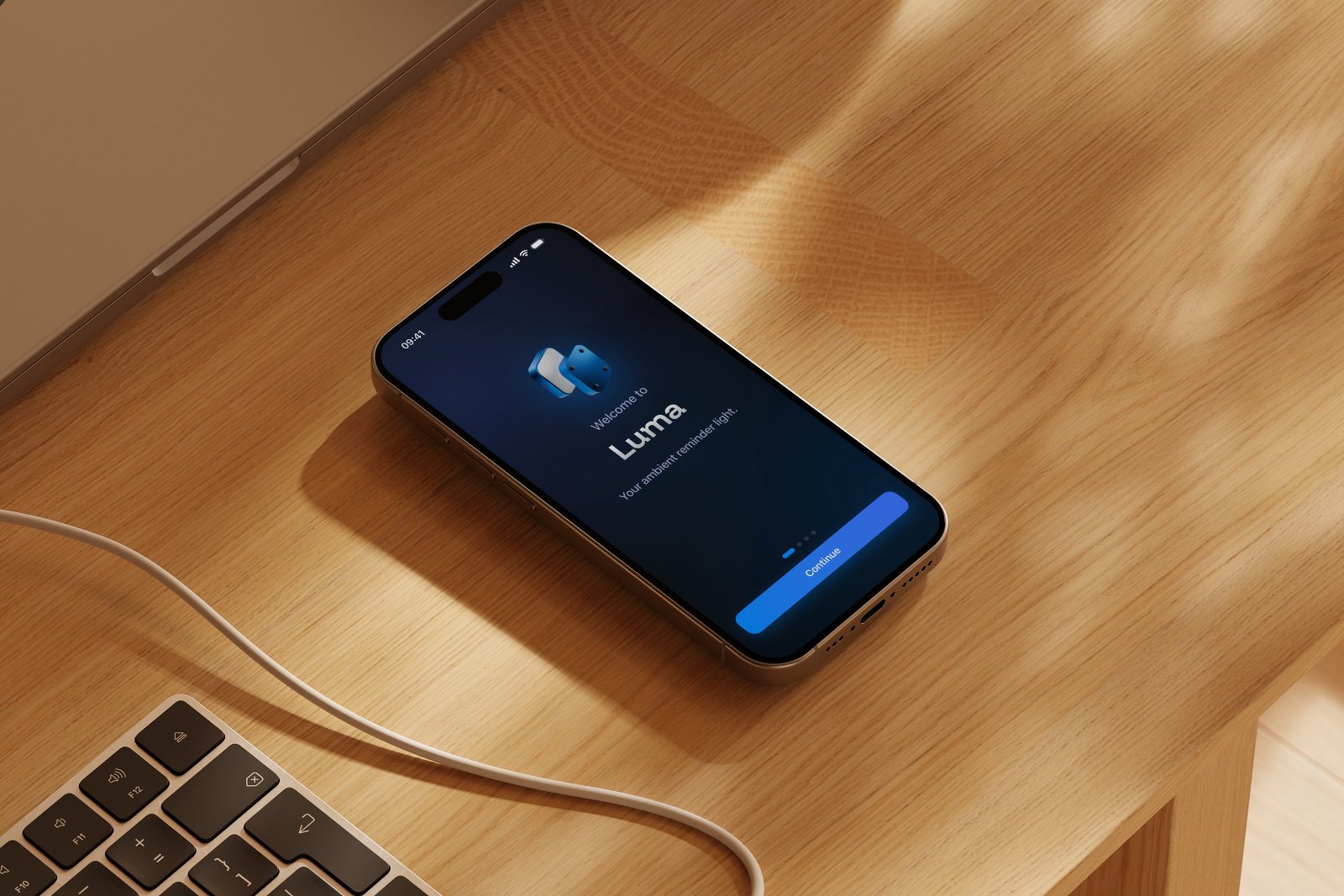
The latest prototype is fully ready for market, along with the companion app, and I have been using its fully functional version for around the past year, and it’s completely served its purpose, replacing many of my irritating reminders and notifications with a light glow.


Luma is still an ongoing project, and as such I continue to iterate, test and perfect. I’m excited to show more soon, so stay tuned!